Wednesday, September 29, 2021

Server Cloud Backups for SMBs- A Great Combo

Data loss can happen to any business, especially when there are so many reasons for data loss such as natural disasters, ransomware attacks, human errors and more. All of these reasons make backup and Disaster Recovery (DR) extremely important especially for servers.

Small to Medium-sized Businesses (SMBs) are no exception to data loss and they require ransomware protection and data loss protection also as their data is also valuable to them. However, certain budget limitations usually restrict them to get a full-fledged backup and DR appliance or solution in which they can back up all of their data and servers.

However, there are some server cloud backup solutions from vendors like StoneFly that offer budget friendly server cloud backups which can act as a savior for SMBs with smaller budgets.

Server Cloud Backup- Great Option for SMBs

Server cloud backup is a great online backup and DR solution for SMBs. As it is affordable, reliable and is easy to use, offering many additional features as well.

The main reason why it is recommended to SMBs is that it is the affordability nature of it. This way, SMBs won’t have to go overboard with their budget in order to get a good server cloud backup solution for their business.

Active Protection Against Data Loss with Server Cloud Backup

Data loss is bound to happen without any data loss protection as there are so many threats of data loss and for SMBs that do not want to lose their mission-critical data and servers, server cloud backup is their best bet as ransomware attacks and data loss can target servers as well so it is best to protect everything beforehand, including servers otherwise, all data would be lost.

Server cloud backup enables SMBs to effectively back up all of their data and servers, whether they are Windows servers or Linux servers, so that they can fight ransomware and recover from their backups without having to pay any hefty amount of ransom money.

Furthermore, SMBs also won’t have to worry about facing any excessive amount of downtime either as with most server cloud backup solutions, businesses are able to recover from backups and continue operations.

Additionally, in the event of a natural disaster, they can even recover their data remotely and continue operations from elsewhere even if their primary site is inaccessible. So, sever cloud backups can offer SMBs a lot more than just backing up data.

Conclusion

Server cloud backup is a great solution for SMBs that are looking to back up and protect their data from the many threats of data loss in a most affordable and reliable way. It offers complete ransomware and data loss protection and offers many features which helps SMBs stay operational even during a disaster.

Monday, August 23, 2021

How to Choose the Best Enterprise NAS Storage for Your Business

 “The cost effective nature of NAS storage makes it a preferred choice among enterprises.” Said Technavio’s lead analyst Rakesh Kumar

Storage drives and storage technology is evolving day by day, similarly the capability of enterprise Network Attached Storage (NAS) for storing data is increasing proportionally. Businesses are always searching for optimized storage solutions. Choosing the right kind of enterprise NAS storage is important for managing enterprise-grade workloads.

SMEs, SMBs, and large organizations can leverage enterprise NAS storage technology for a variety of use-cases and applications. When it comes to choosing the NAS most suited for your business, it may be a bit difficult to pick the right kind of NAS storage without proper guidance.

Consider these questions when choosing an enterprise NAS storage for your business:

Ø  How much storage capacity is needed?

It may sound simple but this question warrants a great deal of preparation and forecasting. Do it wrong and your business ends up with fat provisioned storage resources that consume space, resources, and add no immediate value. Do it right and you get exactly what your business needs; immediately adding value and using resources affectively.


Storage Capacity for Enterprise NAS

 In terms of forecasting storage capacity, file-level storage or NAS storage is ideal because of its scalability. The ability to scale file-level infrastructure enables businesses to setup storage as per their immediate requirements and they can scale when their storage requirements grow. 

A thing to note here is that the ability to scale depends on the vendor and the NAS storage technology. For instance, StoneFly offers a NAS storage solution that can scale into petabytes and they can set it up as a redundant appliance too; giving users the ability to dually scale (performance + storage capacity) their storage infrastructure. 

How “flexible” is the enterprise NAS storage

Enterprise NAS storage can be called “flexible” if it can adapt and accommodate in accordance to businesses’ requirements. Here’s a brief list of what a good enterprise NAS storage solution should offer as a standard:

  • Compatibility with mainstream servers and software.
  • Built-in cloud connect and support for enterprise clouds like Azure cloud storage, AWS cloud, and others.
  • Configurable as an All-Flash, Hybrid (SSD/Flash + SAS/Hard drives), and pure SAS/hard drive NAS.
  • Should support High Availability (HA) configuration and multi-path connections.
  • Should offer data services such as erasure coding, snapshots, replication, and encryption.
  • Should have a modular, redundant, and hot-swappable architecture. 

You might be thinking, that’s a big list. Are there really any enterprise NAS storage solutions out there that provide all of these desired features? Well yes, StoneFly SSO™ NAS delivers these and more.

Conclusion

In the end, every business has their own set of requirements. That’s why what works for most may not work for your business. It is very important to first analyze and understand what your business needs when it comes to data storage. And then begin the search for the ideal enterprise NAS storage.

However, regardless of the industry and the use-case, there are some attributes that should be a part of an enterprise-level NAS storage solution. A NAS appliance has to be flexible enough so that it’s future-proof and has the ability to scale as the business data grows. It has to be reliable so that in the event of hardware failure, the business doesn’t have to endure data loss.

These two are the most important attributes of an ideal enterprise NAS storage solution and a must-have for all businesses. 


Tuesday, July 27, 2021

Advantages of Combining Cloud Backup & Disaster Recovery


There have been a lot of ransomware attacks in the previous year and in this year as well (so far), which has made enterprises and businesses make cloud backup and Disaster Recovery (DR) a top priority in their business plan.

Moreover, security experts are predicting a harsh year for cyberattacks which further highlights the importance of a cloud backup and DR solution but getting two separate solutions can be a hassle, so combining the two (cloud backup and disaster recovery) into one comprehensive solution seems like a better idea and is actually a recommended approach by experts as it offers many advantages.

Reduced Complexity with Cloud Disaster Recovery

Since cloud backup and recovery are merged into a single solution, this significantly reduces the complexity that having multiple solutions might bring. There are no separate discrete solutions for every IT
function which might create a convoluted environment that is difficult to manage and secure.

Improved RTOs & RPOs with Cloud Disaster Recovery

Recovery Time Objective (RTO) and Recovery Point Objective (RPO) are the main parameters to watch when it comes to data protection and DR. With a combined cloud disaster recovery solution, enterprises get a solution that helps them meet their RTO and RPO targets.

Faster Recovery with Cloud Disaster Recovery

Cloud disaster recovery solution can be accessed from anywhere which greatly shortens recovery time. This means that no matter what caused the disaster or what kind of a disaster there is, someone on the recovery team will be able to install the backup files and initiate the disaster response.

Easy Scalability with Cloud Disaster Recovery

Cloud backup and disaster recovery solutions offer perfect number of resources that are available always. This means that whenever the needs of the enterprise increase, they can easily scale up to meet the demand.

Increased Security with Cloud Disaster Recovery

Cloud backup and recovery solutions are protected by state-of-the-art security technology at every layer. From the environment and physical parameter to the data and infrastructure layers, everything is protected. This makes cloud disaster recovery solutions highly secure.

Lower Costs with Cloud Disaster Recovery

Cloud backup and disaster recovery significantly reduces the costs associated with disk storage space and hardware, as well as software maintenance. Moreover, unified solution frees up IT staff workload to work on business-growth initiatives. 

Conclusion

Combining cloud backup and disaster recovery into a single, unified solution offers so many benefits that more and more enterprises are adopting it and more vendors, such as StoneFly, are offering cloud disaster recovery solutions with attractive pricing. So, get a cloud disaster recovery solution today and enjoy the many benefits that come along with it.

Thursday, July 1, 2021

Tips for Reducing Service Downtime with Cloud Backup & Recovery


There is no doubt to the fact that no business wants downtime. They want to reduce it as little as possible. It not only impacts productivity but also risks lost in customers, and can potentially put the business out of business. This is why businesses of all sizes, big or small, want to reduce downtime as much as possible and are actively looking for solutions to do so. Fortunately, cloud backup and recovery solutions go a long way in reducing downtime and maintaining business continuity but only if they are used right.

Cloud Data Backup & Recovery Plan

Nowadays, cyber-attacks have risen quite a lot, and their number is increasing every day. It is best to have a proper backup and recovery plan alongside a cloud backup and recovery solution beforehand in order to avoid any inconvenience during the incident and reduce downtime altogether as a backup and recovery solution alone is not enough to ensure efficient recovery of data.

Apart from cyber-attacks, natural disasters are also a threat to data loss and can cause significant amount of downtime. Without having a proper cloud backup and recovery solution and plan in place, it can be very difficult to continue operations instantly and can result in a lot of unwanted service downtime.

A cloud backup and recovery solution enable businesses to access their data from anywhere in the world and continue operations, even if their primary location has been severely affected. This in return ensures business continuity and reduces the service downtime.

Perform Routine Backups & Back Up Cloud Backup Storage

In order to ensure business continuity and reduce service downtime, businesses need to back up their data regularly. There is no point of having a backup of your data if you’re not able to gain benefit from it so routinely backing up all your files to an off-site location can play an important role in reducing service downtime. 

Other than this, in order to fully ensure that downtime is reduced, businesses need to back up their cloud backup storage as well. This is because cyber-attackers are now also targeting cloud backup storage as they know that many businesses now have backup of data, so in order to force businesses to pay, cyber-attackers are targeting cloud backup storage. So, this makes it vital to back up cloud backup storage also in order to ensure recovery of data when needed and thus reducing downtime.

Conclusion

Service downtime can be both frustrating and damaging for any business. It is an unwanted hurdle which can lead to a huge loss for the business. Fortunately, through proper cloud backup and recovery plan, routine backups and backing up cloud backup storage, businesses can reduce downtime significantly.

Wednesday, May 5, 2021

What Can Hyperconverged Infrastructure Do for your Business?


Hyperconverged infrastructure is a widely used and renowned data storage solution which does not disappoint the users and businesses once they have adapted it.

In this article, we discuss some of the many advantages hyperconverged infrastructure offers businesses and how can they be beneficial.


Hyperconverged Infrastructure is More Focused on Data

Hyperconverged infrastructure plays a very vital role in managing data and is also mainly focused on data itself. Hyperconverged infrastructure takes care of all the data that undergoes transaction of any kind.

Hyperconverged infrastructure is efficient in its own way due to the fact that it manages transactional data storage.

Hyperconverged infrastructure offers data modernization which makes it a very beneficial architecture for enterprises and businesses of all sorts. Hyperconverged infrastructure provides a single point of control and management for the data storage components which makes it possible to have more control and a more dynamic management of the infrastructure.

Hyperconverged Infrastructure & Edge Computing

Hyperconverged infrastructure is a great suitable platform for the edge computing. Edge computing, as we know, is going to be the future of data storage world. So, hyperconverged infrastructure has stepped up with the compatibility and support for edge computing in order to meet the needs of the future and to benefit the businesses in every way possible.

Hyperconverged Infrastructure is Cost-Efficient & Offers Low Cost of Ownership

Hyperconverged infrastructure makes businesses pay less in terms of total cost of ownership. It follows a ‘pay less, get more’ model. When businesses adapt Hyperconverged infrastructure for the first time, they do not predict what benefits and continued ease of management hyperconverged infrastructure have in store for them.

Furthermore, businesses do not have to buy most of the hardware equipment. Hyperconverged infrastructure adjusts and runs on existing hardware equipment a business has. This flexibility and adaptive nature of Hyperconverged infrastructure makes it a very beneficial solution for businesses that are looking for a solution which does not force them to buy the entire infrastructure from scratch.

When businesses keep on using hyperconverged appliance for a longer period of time, it experiences the ease of scalability, flexibility and friendliness in terms of user experience. These are the benefits which are felt only after a considerable time period has been past using hyperconverged infrastructure or a hyperconverged appliance.

The return on investment is guaranteed to be valuable enough that the decision of moving to hyperconverged infrastructure will never be regretted.

Conclusion

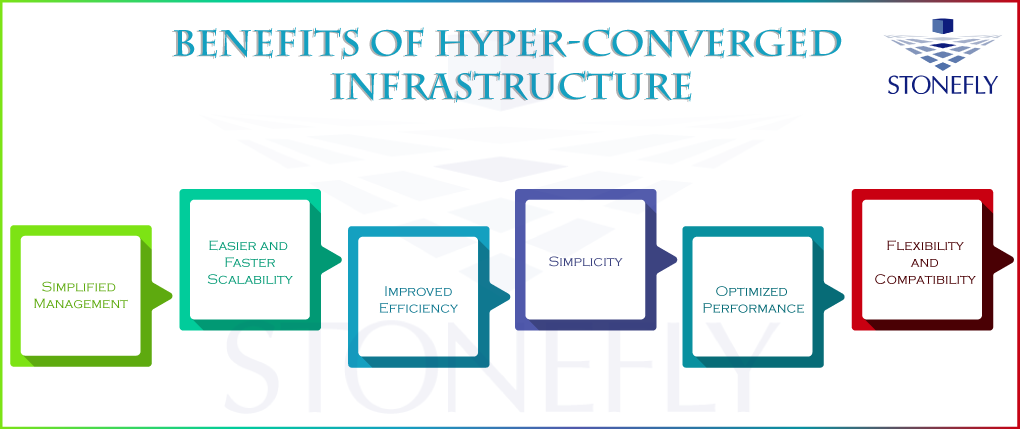
Hyperconverged infrastructure is a data storage solution which does not disappoint businesses in any way once they have adapted to it. It is a solution which offers so much flexibility, simplicity, efficiency and cost savings by combining network, compute and storage to one hyperconverged appliance that reduces the hardware requirements and the overall infrastructure footprint of any business.

Tuesday, April 13, 2021

How Cloud Archiving Can Remove Your Data Archiving Hurdles


Nowadays, enterprises need to meet data storage and archiving related challenges as the data production has significantly increased. These challenges usually arise from lack of on-premises storage space.

Cloud archiving addresses these issues with long-term data storage solutions and with options like scalability, disaster recovery, compliance, etc.


Here are some of the few challenges that enterprises face:

Data Archiving Challenges- Off-Premises Storage Archive

Having on-premises archiving solutions increase the on-premises workloads. This might lead to business disruptions and take up vital resources required for critical business operations. Archiving is considered a very slow process and ‘cold data’ is not treated as critical data and thus resorted to cheaper storage media.

Cloud data archiving solutions shift the responsibility of managing, securing and storing archival data from the hands of the company to the cloud service providers and vendors.

This enables the enterprises to store data for a long-term off-premises as required by the 3-2-1 backup strategy.

Data Archiving Challenges-Achieving Scalability with Cloud Archiving Solutions

Scalability is another challenge faced by enterprises when storing data in on-premises archiving solutions in cheap tier storage.

Having the on-premises flash and fixed-disk storage available for critical business operations is important. That is the reason why enterprises are quickly adopting cloud because they want to liberate on-premises storage for critical workloads and because cloud gateway solutions are scalable.

In just a matter of minutes the enterprise can scale up or down their cloud data archiving solutions.

Data Archiving Challenges- Data Life Cycle

Managing data life cycle and the organization data retention polices for various types of data can also be very challenging. Cloud archiving solutions solve this problem by providing management software that recognizes and classifies the data. This technique gets the job done for managing data based on type. Now, with the data retention policies defined the data can be recycled or deleted without intervention.

Data Archiving Challenges- Compliance

Compliance can be challenging to meet with on-premises solutions. With Azure Blob Storage organizations can archive data into cool blob. Azure cloud storage is compliant to a lot of well know industry standards. This makes it a hit choice for archiving to cloud.

Cloud Archiving Solutions

There are many vendors who offer cloud archiving solutions, like StoneFly. StoneFly’s cloud archiving solution offers smart management, cost reductions, configurable polices, industry compliance and much more.

With features like, image-based snapshots, encryption, unmatched scalability, data analysis, policy-based tiering and much more, make StoneFly’s cloud archiving solution a preferable choice for enterprises.

Conclusion

Cloud archiving has proved to be a wonderful solution for many enterprises belonging to any industry. Cloud data archiving solutions are being used worldwide at a very fast rate. These solutions offer efficient scalability, better data lifecycle management, compliance and saves a lot of storage space.

Wednesday, December 9, 2020

What can Enterprise NAS Storage Offer to Enterprises?

Enterprise NAS storage offers enterprises scalability, reliability, and security. It offers a complete and fully secure data storage solution with so many benefits and advantages. Let’s look at some of these benefits and features in detail. 

Enterprise NAS Storage-File Level Storage

NAS storage solution offers file-level storage. In this storage solution, files, and data can be shared among different devices across the network. It facilitates the running operations of the businesses which require data sharing over a network to make things done faster and more efficiently.

Enterprise NAS Storage- Easy Scalability

A NAS storage solution offers scalability which allows businesses to get more and more storage capacity to meet their increasing data storage space needs. It makes scalability a lot easier and increases it to an extent which makes it a future-proof solution for the enterprises and businesses that are expecting data growth in the near future.


Another thing to note here is that a NAS storage solution is very affordable and offers a lot of convenience to the enterprise. It does not require too much hassle or cost in expanding the storage capacity, as it is made simple and efficient. A NAS storage solution can also be scaled up by adding expansion units and also can be scaled out quite easily as well to add more performance nodes.

Enterprise NAS Storage- Highly Fault Tolerant

NAS storage solutions are highly faulted tolerant due to the many hardware and software features it offers to the users. Talking about hardware features, the power supplies can be made redundant by the vendors and there are some vendors which are offering so many other features as well such as StoneFly. Software features can include encryption, snapshot, and replication to make the data storage infrastructure fault-tolerant at more than one level.

Moreover, a NAS storage solution gives businesses the ability to buy customized versions of their NAS storage so that they do not have to pay for what they do not really need. This makes it a really cost-effective solution as well and more importantly, an efficient and productive one for many enterprises and businesses.

With a NAS storage solution, enterprises can have low Capital Expenses (CapEx) and (Operational Expense (OpEx). This makes a NAS storage not only a reliable solution but also an affordable solution also.

Conclusion

Enterprises and businesses can get a lot of benefits and advantages from NAS storage. From scalability to data security, enterprise NAS storage solution is a cost-effective solution and covers all the aspects for a great user experience which makes it reliable and convenient.